What Letting Go Actually Feels Like A decluttering story about paper, memory, and finally choosing myself.
I didn’t set out to have an emotional reckoning.
I set out to clean my office.
My husband had been on me about it for a while…years actually. Get it organized, clear it out, just do it. From the outside, it probably looked simple. A room. Some paper. A few shelves. But every time I tried, I would do a little bit, stop, walk away, and not open that door again for months.
What I didn’t understand then, but understand now is that the room wasn’t the problem.
The weight was.
Once I finally got in there and created a system, I was okay. I could function. But I needed help getting to that point. He saw it as procrastination, but it wasn’t. I was having physical reactions just being in the space; tight chest, overwhelm, resistance, exhaustion. Getting rid of things wasn’t neutral. Sitting in the room wasn’t relaxing. And for a long time, I couldn’t even explain why.
Now I can.
Paper Is Protection (Until It Isn’t)
Paper has always felt safe to me.
It holds proof. Evidence. Memory. Control.
As a teacher, we used to joke: If it’s not written down, it doesn’t exist.
That mindset didn’t stay at school. I carried it into my life.
I kept receipts. Notes. Emails. Old planners. Journals. Paperwork long past its usefulness. My husband joked that I can pull a receipt for anything, and he’s right. I could tell you what was said, when it was said, and why it mattered.
But it wasn’t about being right.
It was about protection.
My therapist helped me name it. So did the professional organizer Kiaunna with Ki to Declutter who helped me years ago. When I reached back out to her, she didn’t tell me to “just get it done.” She gave me permission to move slowly: fifteen-minute increments, don’t eat beforehand, work for two hours max, then walk away. She even sent me worship music playlist.
That changed everything.
Because once I slowed down, the memories showed up.
The Moment That Broke Me Open
I found things I swore were already gone.
A book of poems I wrote in the early 2000s. I honestly thought those had disappeared years ago. When I pulled it off the shelf, I was stunned, not emotional, just shocked. How were these still here? How had entire chapters of my life been sitting on a bookcase, untouched, collecting dust?
Normally I would go through them, but this time I didn’t reread the poems.
I shredded them.
Not because they weren’t meaningful but because they were. And I don’t need to carry every version of myself forever to honor who I’ve been.
Then I found a journal entry from 2015. At the top of the page was my dad’s hospital room number: 1547. I noticed the digits add up to 17, the year I got married. I don’t know if that means anything. Maybe it doesn’t. But in that moment, it felt like a quiet thread connecting grief, love, loss, and survival.
I sat with it briefly.
Then I let it go.
Paper holds memory, but it also holds expectation, waiting, and pain we never properly released.
This Wasn’t Decluttering, It Was Grieving
I took five pounds of paper to UPS to shred.
Five pounds.
Between shredding at home, throwing things away, and donating what no longer belonged to me, I probably released close to fifty pounds of paper.
That’s ridiculous!
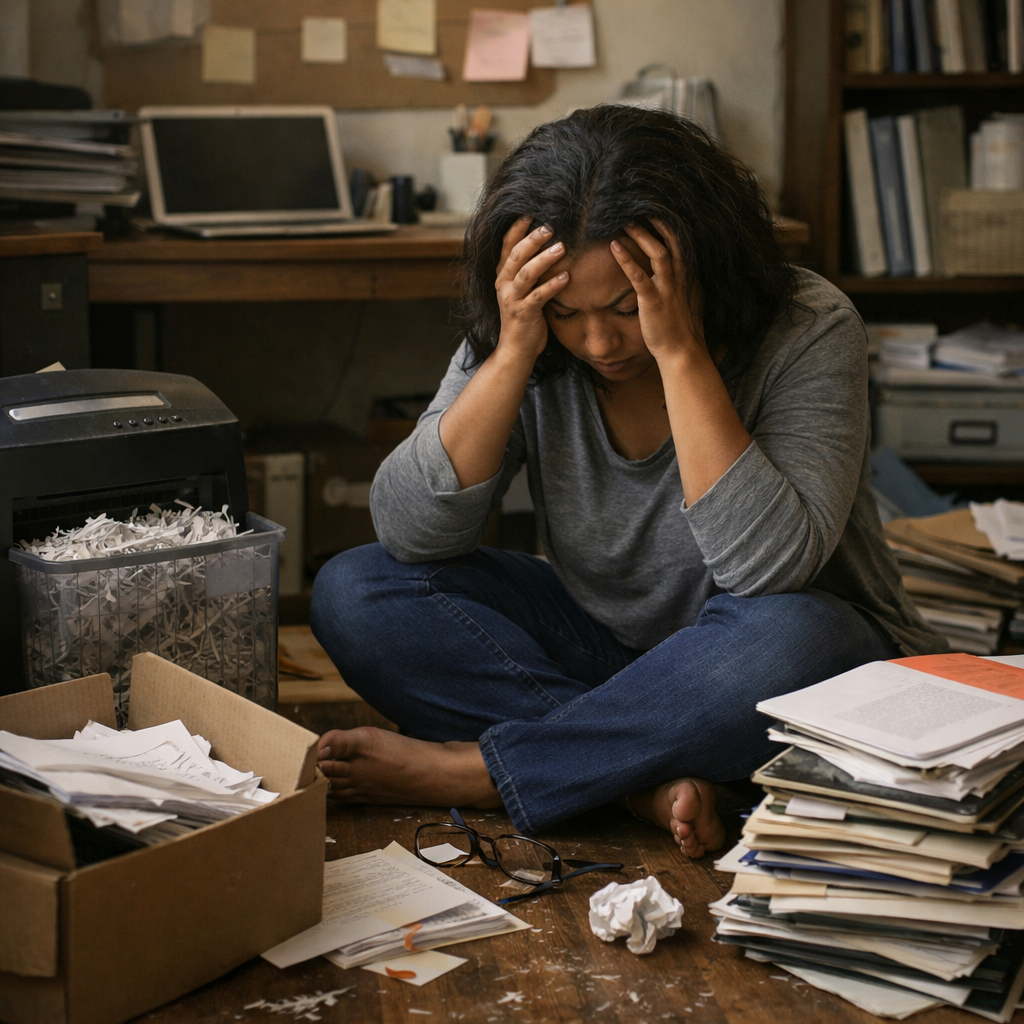
At one point, my shredder started making a knocking noise. I had to buy lubrication sheets to keep it going. That’s when I realized something else: the shredder itself had been full for nearly a year. Shredded paper just sitting there. Finished, but not emptied.
That felt symbolic.
So I made a decision: everything had to go. Shred it. Bag it. Remove it. No more holding onto what had already done its job.
And then something unexpected happened.
I felt lighter.
Not metaphorically. Physically. A friend even commented on it, she said I seemed less heavy. I told her the truth: I feel lighter.
My body confirmed it too. Tightness gave way to calm. Resistance turned into relief. When I finished for the day, I walked into the space and felt peace. Real peace.
I took a nap in there today, I haven’t done that in years. There chair was covered with stuff.
When the Space Changes, Creativity Returns
My office is finally doing what it was always meant to do.
It’s a retreat.
A creative space.
A place where the magic happens.
I can feel my creativity coming back. I see doors opening, literally and figuratively. I can sit in the room without bracing myself. I can breathe.
There are still a few things to tidy up, and that’s okay. This wasn’t about perfection. It was about release.
My therapist said the paper was a way I protected myself. She was right.
For years, I needed proof. I needed records. I needed something to point to in case I was questioned, misunderstood, or dismissed. But as I choose myself fully, honestly and I realize something profound:
I don’t have to protect myself like that anymore.
What Remains Matters But It Doesn’t Own Me
What’s left is intentional. Labeled. Manageable.
No longer a shrine to who I used to be.
No longer a silent weight in the room.
Just what I need.
Nothing I don’t.
Decluttering taught me this:
You don’t owe your past unlimited storage.
You’re allowed to choose space.
You’re allowed to choose peace.
You’re allowed to choose now.
And sometimes the bravest thing you can do
is feed the shredder, close the door,
and walk away lighter. Letting go of the paper didn’t erase my story.
It clarified it.
As I stood in my office; lighter, calmer, finally able to breathe I realized something I hadn’t fully named before: I’ve spent a lot of my life surviving. Documenting. Proving. Holding on just in case.
Writing A Case of the F&$.!#%K-Its! was the first time I stopped asking for permission to tell my truth. It was the moment I chose release over explanation, presence over protection, honesty over performance.
This season of decluttering feels like an extension of that same decision.
The book isn’t about throwing your life away.
It’s about deciding what no longer gets to weigh you down.
If this story resonates if you’ve ever felt stuck in the in-between, holding onto things you can’t quite explain you’re not alone. Sometimes the bravest “F&$.!#%K-it” isn’t loud or dramatic.
Sometimes it sounds like a shredder.